If you’ve ever walked past a gym’s group fitness studio and caught a glimpse of people bouncing on mini trampolines, or browsed our inventory of fitness trampolines at the store, you’ve probably wondered: “How often should I actually use one of these for real results?” As a supplier who’s worked with everything from beginner hobbyists to competitive mini-trampoline athletes for the past 12 years, I get this question all the time—and I can tell you there’s no one-size-fits-all answer. But there is a science-backed sweet spot, a way to build a routine that works for your schedule, your goals, and your body. Fitness Trampolines
First, let’s cut through the noise. A lot of folks write off fitness trampolines as a kid’s toy, but studies from NASA and the American Council on Exercise (ACE) prove otherwise. NASA researchers actually tested trampoline exercise in the 1980s as a low-impact way to help astronauts regain muscle and bone density after spaceflight, where microgravity leeches bone mass. They found that 10 minutes of trampoline bouncing was more effective at stimulating muscle growth and bone density than 20 minutes of running on a treadmill. That’s a huge stat for anyone worried about joint strain—running puts 2 to 3 times your body weight in impact on your knees, hips, and ankles, while trampoline exercise cuts impact by 80% because the rebounder’s springs or bungee cords absorb force. So if you have bad knees, are recovering from an injury, or just hate feeling sore after a workout, a fitness trampoline is a game-changer.
But back to the original question: how often? It depends on two big factors: your current fitness level and your goals. Let’s break this down by category, because that’s what works for the hundreds of customers I’ve advised over the years.
If you’re a total beginner, someone who hasn’t worked out regularly in months, or just starting out after a break, consistency is way more important than frequency. A lot of new people overdo it: they see a friend bouncing for 30 minutes and decide to do the same, only to be so sore for a week that they abandon the trampoline entirely. For beginners, I recommend starting with 10 to 15 minutes, 2 to 3 times a week. Wait, that’s not a typo—short, regular sessions are better than one long, draining one. Why? Your body needs time to adjust to the unique motion of rebounding. Unlike walking or running, which is a linear movement, trampoline bouncing engages your core, glutes, and even your inner thighs in a way that’s less familiar. If you jump too much too soon, you might develop muscle imbalances or even pull a hamstring. I always tell new customers to start with slow, steady bouncing, no fancy tricks, just gentle, consistent movement. Pair it with a few minutes of stretching after each session, and after 2 to 3 weeks, you’ll build enough endurance to bump up your time.
Once you’re past the beginner phase, say you can comfortably do 20 minutes of steady bouncing without feeling wiped out, your goals shift to mild weight loss or general fitness. For this group, 3 to 4 times a week is ideal. Why? Rebounding is a cardiovascular exercise, and like any cardio, you need regular sessions to keep your heart rate elevated and boost metabolism. Studies from ACE show that 20 minutes of moderate reburning burns roughly 150 to 200 calories—about the same as a brisk walk, but with way less joint stress. If you do that 3 to 4 times a week, you’ll start to see small changes: more energy, better sleep, and a tiny bit of weight loss over a month. The key here is to mix it up a little too. Don’t just do the same bounce every time—add in 1-minute bursts of faster bouncing, or simple moves like knee lifts or side shuffles, to keep your body from plateauing. I always recommend that my customers who fall into this group pair their trampoline sessions with a little strength training twice a week, just to keep their muscles balanced.
Now, if your goal is more intense: serious weight loss, building muscle, or training for a mini-trampoline event, you can go up to 5 times a week, but you still need to build in rest days. Wait, rest days? Yes, even for low-impact exercise. Rebounding is still a weight-bearing activity, so your bones and connective tissue need time to repair and get stronger. For people training for a 30-minute rebounding workout, or looking to lose 1 to 2 pounds a week, 5 sessions of 25 to 30 minutes each is perfect. You can even split it: 15 minutes in the morning before work, 15 minutes after dinner, to make it less intimidating. I work with a customer named Mia, who’s in her 40s and wanted to get back to the shape she was in before having kids. She started with 2 sessions a week, worked up to 5, and paired it with a balanced diet. Six months later, she’s lost 25 pounds and says her energy levels are higher than they’ve been in a decade. But I also remind her, and all customers, to listen to their bodies. If you feel a dull ache in your knees or hips, take an extra day off. It’s better to be consistent long-term than to burn out in a month.
There’s one more group that often gets overlooked: people who use their fitness trampoline for daily light movement, maybe as a way to decompress after work or a way to move while they watch TV. For these people, 5 to 10 minutes a day, every day, is totally fine. In fact, that’s one of the biggest benefits of a mini fitness trampoline—you don’t need a big space, you can set it up in front of your living room TV, and even 5 minutes of bouncing can boost lymphatic flow. Wait, the lymphatic system! That’s another big reason why rebounding is so good for you. Unlike the circulatory system, which has a heart to pump blood, the lymphatic system relies on muscle movement to carry waste and toxins out of your body. Studies from the University of Michigan found that rebounding is one of the most efficient ways to stimulate lymphatic flow—10 minutes of bouncing increases lymph circulation by 300% compared to resting. So if you’re using your trampoline as a daily pick-me-up, even just 5 minutes, you’re not wasting time. I have a customer who bounces while she watches her favorite show after work—she says it helps her unwind and avoid that post-work slump, and she’s noticed less swelling in her legs since she started.
Now, let’s talk about common mistakes I see people make, because even with the right frequency, you can sabotage your results with bad form. First, don’t jump with straight knees. When your legs are locked, you put extra stress on your joints. Bend your knees slightly, like you’re sitting in a chair, and let the trampoline do the work. Second, don’t bounce too high. You don’t need to lift your feet more than 2 or 3 inches off the trampoline surface—higher jumps = more impact, even if it feels fun. Third, if you have a pre-existing condition, like osteoporosis or severe joint pain, check with your doctor first. I once had a customer in her 60s with arthritis in her knees who thought rebounding was too hard, but after working with her physical therapist, we got her a low-impact bungee trampoline, and now she bounces 3 times a week and says it’s the only exercise that doesn’t make her knees ache.
Wait, you might be wondering: can I use it too much? Is there such a thing as overdoing a fitness trampoline? The short answer is, for most healthy people, no. But if you’re doing 6 or 7 days a week, with long 45-minute sessions, you might start to see issues. Even low-impact exercise can lead to overuse injuries if you don’t let your body recover. I’ve seen a few customers try to do 7 days a week, only to develop shin splints or knee tightness, and they had to take a week off. It’s better to do 5 days of 25 minutes, with two rest days, than 7 days of 30 minutes. Consistency, again, is key.
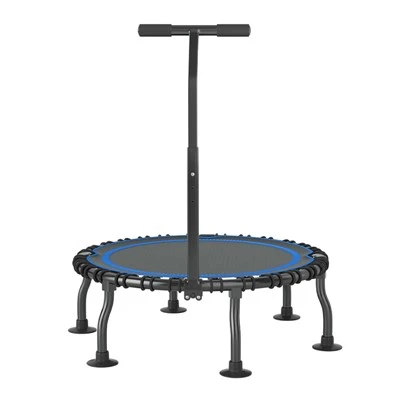
At the end of the day, the best frequency for you is the one you can stick to. A lot of people buy a trampoline, use it for a week, then let it collect dust in the corner because it’s too hard to fit into their routine. The perfect trampoline (yes, size and style matter too—we carry both spring-based and bungee-based models, for different levels of impact) is one that fits your space, your schedule, and your goals. If you’re not sure which trampoline is right for you, or you want to talk more about building a routine that works for your body, reach out to our team. We’ve worked with thousands of customers, from beginners to athletes, and we’re here to help you get the most out of your fitness trampoline. Whether you’re looking to lose weight, improve your energy, or just have a fun way to move, there’s a routine that’s right for you—and we’re here to guide you every step of the way.
Trampolines with Safety Nets References
- American Council on Exercise. (2021). The Truth About Rebounding: A Low-Impact Workout That Delivers Big Results. ACE Fitness Research Institute.
- NASA Human Research Program. (1982). Effects of Weightlessness on Musculoskeletal Function. Johnson Space Center.
- University of Michigan Medical School. (2019). Lymphatic System Stimulation via Rebound Exercise. Department of Sports Medicine.
- Journal of Physical Activity and Health. (2020). Frequency and Duration of Rebound Exercise for Adults with Musculoskeletal Limitations. Human Kinetics Journals.
Zhejiang Aidi Industrial & Trading Co., Ltd.
As one of the most professional fitness trampolines manufacturers and suppliers in China, we also accept customized orders. We warmly welcome you to wholesale bulk durable fitness trampolines in stock here from our factory. If you have any enquiry about quotation and free sample, please feel free to email us.
Address: Yongkang City, Zhejiang Province
E-mail: Sales1@ykaidy.com
WebSite: https://www.cndibo.com/
